Originally focused on advancing clinical understanding and management of PBC, the program expanded to incorporate late-onset genetic cholestasis and PSC, creating a comprehensive educational resource across the spectrum of rare cholestatic liver disorders.
One centralised learning hub
- The development of a centralised, hub-based microsite inclusive of educational resources across three therapy areas, bringing regular, up to date conference data from 2023-2026, alongside more complex program formats, enduring emerging scientific data are not only disseminated but contextualized and translated into real-world clinical practice, with practical tools and expert explanations augmenting factual updates.
Continuous development informed by outcomes
- As part of an ongoing needs assessment, outcomes data have been the primary driver of the program’s evolution, complemented by literature review and learner surveys to identify persistent educational gaps and unmet needs – these insights have directly shaped enhancements to content, formats, and tools.
- The education continues to adapt as new data emerge, ensuring relevance and responsiveness to clinician needs within rapidly evolving disease landscapes.
A global audience
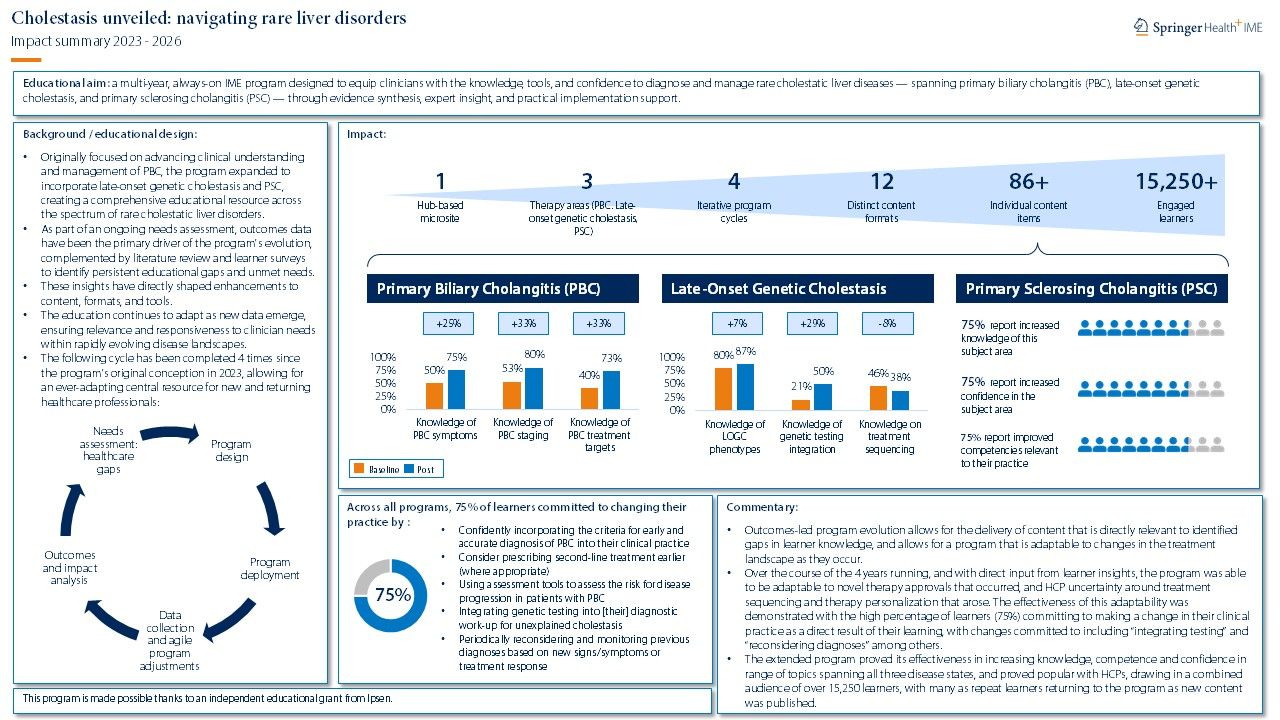
- Across all indications to date, Cholestasis Unveiled has engaged more than 15,250 learners globally, demonstrating broad reach and sustained relevance.
Directly addressing ongoing learner needs
- Over the course of the 4 years running, and with direct input from learner insights, the program was able to be adaptable to novel therapy approvals that occurred, and HCP uncertainty around treatment sequencing and therapy personalization that arose. The effectiveness of this adaptability was demonstrated with the high percentage of learners (75%) committing to making a change in their clinical practice as a direct result of their learning, with changes committed to including “integrating testing” and “reconsidering diagnoses” among others.
- Outcomes assessments confirm that learners not only increased their disease-specific knowledge but also reported higher confidence and skill in applying learnings, reflecting real world educational impact and practice readiness.
Impact poster
Program formats
News coverage form key congresses and key data releases | Clinical perspective podcasts | Expert discussion video podcasts | Infographic | Cased-based eLearning | Downloadable slides | Animated pathophysiology and genetics video on late-onset genetic cholestasis | Clinical pathway tool
Faculty
Drs Richard Thompson, Verena Keitel–Anselmino, Silvia Vilarinho, Deepak Joshi, Rosa Miquel, Mitchell Shiffman, Kris Kowdley, Andreas Kremer, Marlyn Mayo, David Jones, Gideon Hirschfield, Palak Trivedi, Mo Christie, Marco Carbone, Mark Swain, Adriaan Van der Meer, Emma Culver, Raj Vuppalanchi, Daniel Pratt
Target audience
This program was primarily aimed at a global audience of hepatologists and gastroenterologists, and is relevant to all members of the multidisciplinary team that manages PBC/PSC/late-onset genetic cholestatic patients.
Related programs
-

Improving PSC care through expert-guided strategies
News articles Sustained responses to elafibranor Gut microbione may influence PSC development Survey reveals limitations to pruritis assessment in PSC AASLD 2025 reflections: key takeaways in PSC
-

Improving PBC outcomes by prioritizing patients’ needs
News articles ELATIVE: Sustained elafibranor benefit and biomarker potential Seladelpar improves wellbeing and lowers itch impact AASLD 2025 reflections: key takeaways in PBC
-

Unveiling the spectrum: A deep dive into late-onset genetic cholestasis
News articles AASLD 2025 reflections: key takeaways in late-onset genetic cholestasis Gene mutations linked to adult cholestasis Contraceptives linked to unique cholestatic phenotype